
NFPA 1002 pump operator practice test: quizzes, flashcards, and a real pump simulator
Most pump ops test prep stops at memorization. Drill the quizzes and flashcards to lock in pump theory, hydraulics, friction loss, and pump discharge pressure, then prove you can do it on a physics-based pump panel that runs in your browser.
Practice quizzes and flashcards for the written exam
The fastest way to study: a question bank built around the NFPA 1002 pump operator competencies, drilled the way you actually retain it.
NFPA 1002 practice quiz
Build a custom quiz from the question bank, pick how many questions, and choose immediate or end-of-quiz feedback with an explanation on every answer. Every attempt is saved so you can track where you stand.
Start the practice quizPump ops flashcards
Flip through the question bank one card at a time to drill recall and speed. Cards reshuffle on every run, so you learn the material, not the order they happen to come in.
Drill the flashcardsSample NFPA 1002 practice questions
Work these the way you would on the exam: read the question, commit to an answer, then open it to check yourself. Each one shows the correct answer and why the others are wrong.
1.Which of these is the pump operator’s most important responsibility on the fireground?Show answer
Driving the apparatus to the scene as fast as possible
Speed is secondary to safe arrival and reliable water delivery.
Delivering the right water at the right pressure to firefighters on the lineCorrect
Coordinating radio traffic for the incident commander
That is the IC or radio operator’s role — the pump operator stays at the panel.
Being the first to enter the structure with a hose line
The pump operator stays with the apparatus to manage water delivery.
2.Which statement correctly distinguishes split-shaft drive from PTO drive?Show answer
Split-shaft routes engine power through the transmission and requires the apparatus to be stationary; PTO drives the pump independently and can pump-and-roll.Correct
PTO is mechanically stronger and is therefore preferred on full-size structural engines.
PTO is common on brush rigs and some quints precisely because it allows pump-and-roll, not because it’s stronger. Split-shaft is the dominant drive on structural engines.
Split-shaft is an older, simpler system that has been replaced by PTO on most modern apparatus.
Split-shaft is current technology and is the standard on most modern structural engines. PTO solves a different problem (pump-and-roll), not a generational one.
Both systems require the apparatus to be stationary; the difference is only in the engagement control.
PTO does not require the apparatus to be stationary — that capability is the whole point. The drivetrain isn’t split, so the wheels and pump can be powered at the same time.
3.You are flowing 150 GPM through a 200-foot 1¾" line. Crews swap to a higher-flow nozzle and the same line is now flowing 250 GPM. Roughly how does the friction loss change?Show answer
It increases by about the same factor as the flow — roughly 1.7×.
That would be true if friction loss were linear in flow. It isn’t. The Q² term in FL = C × Q² × L means friction loss scales with the *square* of the flow.
It roughly doubles.
Doubling would be the answer if flow had doubled and FL were linear. Here flow went up by a factor of 1.67, and the FL formula squares that — so the change is closer to 2.8×, not 2×.
It roughly triples (about 2.8× the original).Correct
It stays about the same — hose length, hose size, and the pump are unchanged.
Length and hose size set the C and L terms, but FL also depends on flow. Higher flow through the same hose means more turbulence and more friction loss.
4.Which expression correctly states pump discharge pressure (PDP) for a working hose lay?Show answer
PDP = NP + FL + EL + AL (nozzle pressure plus friction loss plus elevation plus appliance loss).Correct
PDP = NP × FL (nozzle pressure multiplied by friction loss).
The terms add, they don’t multiply. Friction loss, elevation, and appliance loss are all pressure costs that stack on top of the nozzle’s required inlet pressure.
PDP = NP + FL only — elevation and appliances are negligible on most fires.
Elevation matters on any structure above one floor and is the easiest term to forget. Appliance loss matters on standpipes, master streams, and any wye flowing > 350 GPM. Dropping either can leave you 25 psi or more short.
PDP = (NP + FL) × an elevation correction factor.
There’s no multiplicative correction factor in the standard formula — elevation is added in directly at ~0.5 psi per foot.
5.A discharge relief valve solves which specific problem?Show answer
Sudden discharge pressure spikes — for example when a crew slams a nozzle shut — by dumping water back to the intake side of the pump.Correct
Holding a steady discharge pressure as crews open and close lines.
That’s the pressure governor’s job. The relief valve is passive and reactive — it doesn’t hold pressure, it just bleeds off spikes.
Protecting the intake plumbing from negative pressure during drafting.
That’s the function of an intake relief or vacuum protection device, not a discharge relief valve. Different side of the pump, different problem.
Preventing the pump from cavitating when supply runs low.
Cavitation comes from inadequate intake supply. A discharge-side device can’t fix an intake-side starvation problem.
6.You're flowing two lines off a hydrant. The discharge gauge has started to dance, flow is dropping despite you opening the throttle, and the intake gauge is sagging toward zero. What's happening, and what's the right first move?Show answer
The pump is cavitating because demand is exceeding supply. Reduce flow — have a crew gate down or shut a discharge — before adding more throttle.Correct
The governor is failing. Switch to RPM mode and add throttle manually until pressure stabilizes.
The governor is doing its job — it's pushing throttle up because pressure is sagging. The supply, not the governor, is the problem. More throttle on a cavitating pump makes it worse.
The relief valve is dumping. Raise the relief setpoint to keep more pressure available.
A dancing discharge gauge with a sagging intake is a supply-side signal, not a relief-valve event. Raising the relief threshold doesn't add water that isn't there.
The hose has a kink. Send a crew member to walk the supply line.
A kink is one possible cause but not the most likely on a multi-line operation pulling near supply capacity. The right first move is reducing demand; you can troubleshoot the supply path while you do that.
Most NFPA 1002 practice tests stop at memorization
Quizzes and flashcards get you through the written exam. They do not put your hands on a panel. Here you get both, so the day you sit for the practical you have already done the reps.
Textbook study
Theory, formulas, vocabulary
No hands-on practice. No feedback when you do the math wrong.
Flashcards & quizzes
Memorization, recall speed for the written exam
Tests what you remember, not what you can do at the panel.
Apparatus time
Closest to the real practical
Expensive, scheduled, scarce. You get the truck for an hour, not for reps.
This site
Quizzes and flashcards for recall, plus unlimited panel reps with realistic physics
Not a literal apparatus, but covers every NFPA pump JPR you can practice without one.
Then practice on a real pump panel
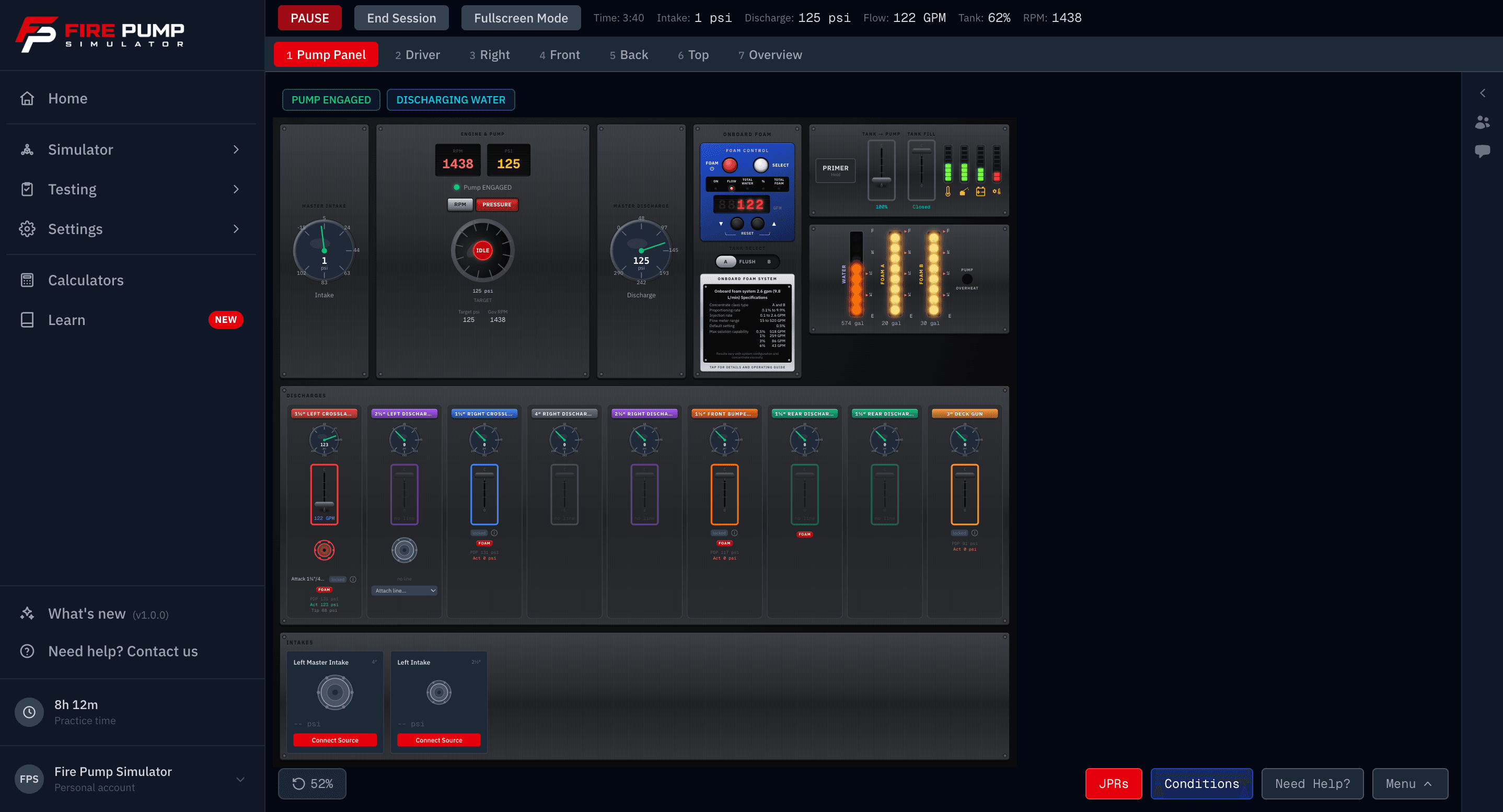
The simulator runs the same panel you will operate on the NFPA 1002 practical: discharge pressure gauges, intake gauge, throttle and RPM, individual discharge valves, and water source selection.
Reading the book is not the same as running the pump
You can read the IFSTA Pumping Apparatus Driver/Operator manual cover to cover. You can ace every multiple-choice on friction loss. But when you sit at an unfamiliar panel for the first time, with a captain on the line asking why his nozzle pressure just dropped, knowledge is not what saves you. Reps are.
Apparatus time is expensive and scarce. Academy seat hours are limited. Most candidates walk into the practical with a fraction of the panel time they actually need to be smooth. The simulator closes that gap: unlimited reps, on the schedule that fits around your shifts.
What you can practice on the panel
Every task is scripted with hints, pass/fail conditions, and feedback. Run them in order to build a complete skill base, or jump to the one your next exam scenario looks like.
Pump engagement
NFPA 1002 §5.2: Operate the apparatus pump
The first thing a pump operator has to do at every call is get water flowing safely. Practice the full cold-start sequence on both split-shaft and PTO apparatus, including the safe shutdown at the end.
Split-shaft cold-start engagement
Park, set the parking brake, shift the transmission, engage the pump, and confirm the OK-to-pump light, all in the right order.
PTO cold-start engagement
Engage a power-take-off pump while the apparatus remains in drive, the way many midship and rescue pumpers operate.
First flow from a split-shaft pump
Open the tank-to-pump, then the discharge, then bring the throttle up to the right RPM to make water at a useful pressure.
First flow from a PTO pump
Make first water from a PTO setup: same hydraulic outcome, different drivetrain path to get there.
Safe shutdown sequence
Close discharges, ease the throttle down, close the tank-to-pump, and disengage the pump without water-hammering the system on the way out.
Water supply
NFPA 1002 §5.2: Establish water supply from internal tank, hydrant, and static source
Pumping the booster tank is easy. Building a sustained supply from a hydrant, direct pumping/nurse unit, or static source (and transitioning between them without losing pressure on the line) is the part operators get tested on.
Connect a pressurized hydrant supply
Hook the supply line, bleed the air, open the intake gate, and pick up pressure without surging the discharge.
Transition from tank water to a hydrant
Practice the changeover sequence so the discharge pressure never drops below the nozzle while you swap supplies.
Draft from a static water source
Drop a hard suction, set the strainer, prime the pump, and pull a sustainable draft, including dealing with vacuum loss and strainer restriction.
Recover when your tank runs low
Recognize a falling tank level before the operator does, and secure a supplemental supply before the line goes flat.
Pump discharge pressure
NFPA 1002 §5.2: Pump a handline and master stream device
PDP problems are where pump operator candidates get stuck on the certification exam, and where pumps blow nozzle operators off the line on real calls. Drill the math, then prove it on the panel.
Set PDP on a single line
Calculate nozzle pressure + friction loss + elevation, dial in the governor, and verify on the discharge gauge that the math was right.
Set PDP across two different lines
Two different hose layouts, two different friction losses, two different target pressures: manage both with one pump.
Set PDP for multiple lines at the same pressure
When all lines need the same pressure, you set the governor once, but only if your hose layout and nozzle selections actually match.
Set PDP using a discharge relief valve
Configure and trip a discharge relief valve so a sudden line closure does not spike pressure back through your nozzle operators.
Produce a foam stream through an in-line eductor
Set the inlet pressure at the eductor rating, match the nozzle flow, and keep back pressure low enough that the venturi keeps drawing concentrate, then flush the eductor clean before you shut down.
Problem recognition and recovery
NFPA 1002 §5.2: Recognize and respond to pump damage conditions
The simulator models real failure modes (cavitation, water hammer, deadheading, and pump overheating) so you can rehearse the recovery before you have to do it on shift.
Recognize and recover from cavitation
Spot the gauge needle bouncing and the RPM-flow mismatch, then back off the throttle, throttle-gate, or governor to stop pulling vacuum.
Recirculate water via the tank-fill line
Keep a deadheaded pump from cooking by opening a tank-fill bypass so the casing has somewhere to send the heat.
Built on NFPA-calibrated physics, not arcade approximations
The simulator behaves the way real pumps behave because the underlying model is built from the same NFPA standards your exam is based on.
- NFPA 1962 friction loss
- Hose friction loss is computed with the published coefficients for 38, 45, 65, 76, and 100 mm hose at any length and elevation, the same numbers your PDP calculations are graded against.
- NFPA 291 hydrant flow
- Hydrants project flow at 20 psi residual using the static / residual / pitot method, and the classification (AA, A, B, C) falls out of the math, not out of a lookup table.
- Pump heat model
- Deadhead a pump and the casing temperature climbs at roughly 10°F per minute at 150 psi rise and 25°F per minute at 200+ psi. At 250°F casing, you have damaged the pump. The consequences are real.
- Cavitation, water hammer, drafting
- Vacuum lift degrades realistically with elevation, water temperature, and strainer fouling. Close a discharge valve too fast at high flow and the pressure spike will show up on the gauge. Pull too hard at draft and you will cavitate.
- Venturi eductor pickup
- Foam pickup follows real venturi behavior: inlet pressure has to sit near the eductor rating, nozzle flow has to match, and back pressure above 65% of inlet stalls the draw. A live foam quality readout shows lean, rich, or good against the concentrate’s rated range.
Want the structured version? Take the course.
The quizzes, flashcards, and simulator stand on their own. If you want a guided path through the material with worked problems and a certificate at the end, the study course pulls it all together.
One-time. Lifetime access. First chapter is free.
- · 9 chapters · ~2 hr 30 min of reading
- · Mapped to NFPA pump operator competencies
- · Worked PDP problems with answers
- · Quizzes and sim tasks embedded in each chapter
- · End-of-course completion certificate
Frequently asked questions
Is there an NFPA 1002 practice test I can take?
What topics do the practice questions cover?
What is NFPA 1002, and does the new NFPA 1010 change anything?
Will this prepare me for my actual certification exam?
Do I need to download or install anything?
How realistic is the physics?
What devices does it work on?
Is this affiliated with NFPA or IFSTA?
Take your first NFPA 1002 practice quiz
Create an account and you are answering questions, flipping cards, and running the panel in under a minute.